At TrackingTheWorld, we have built GPS tracking devices and software since 2003. This guide explains what really drives battery-powered GPS tracker battery life and what you can do to get more out of every charge.
It is usually the first question people ask about a portable tracker, and it is a fair one. A tracker that dies in the field cannot tell you anything. The honest answer is that battery life is not one fixed number. It depends on how the tracker is set up and how it is used.
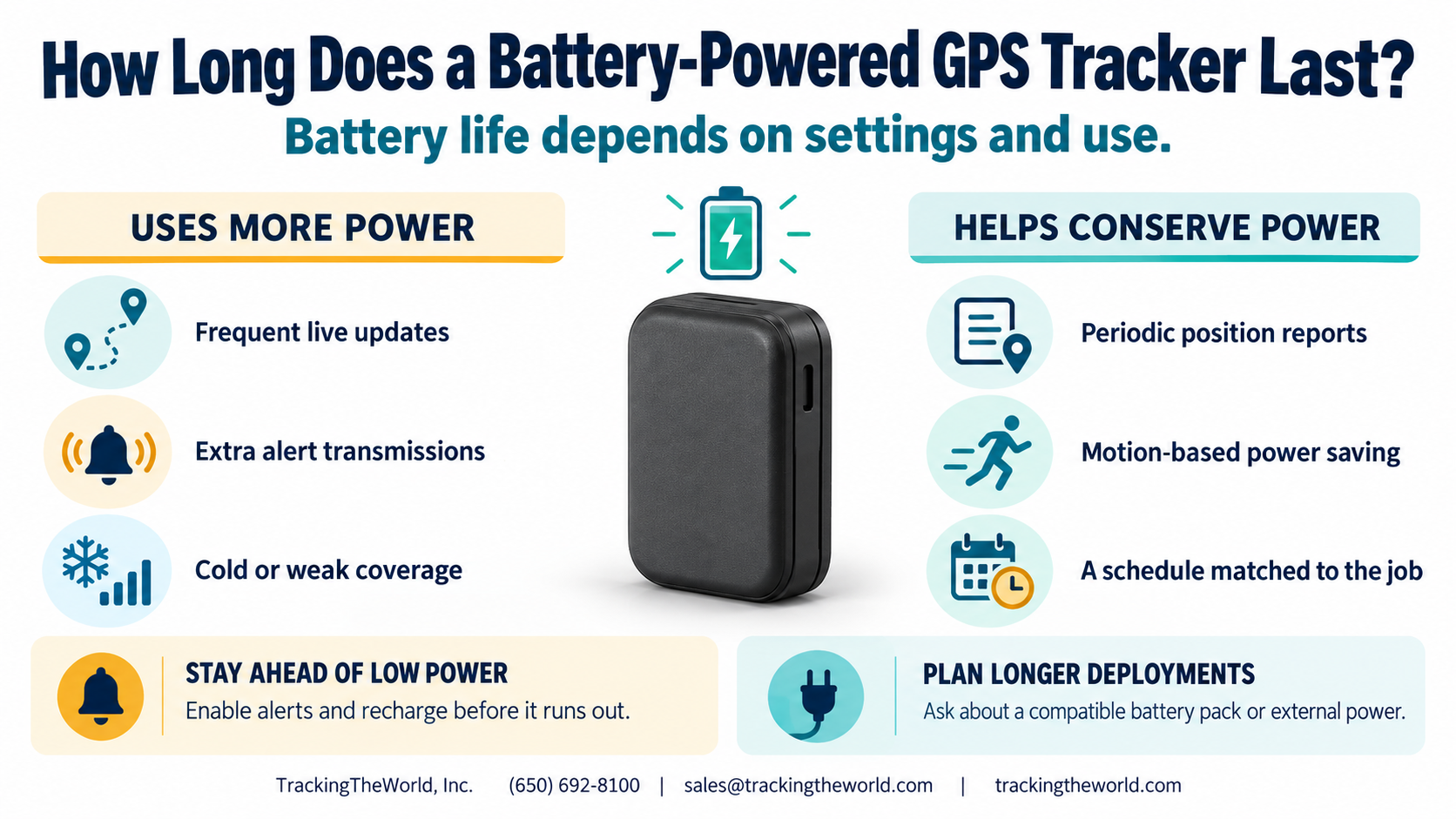
| What Drains the Battery Faster | What Helps It Last Longer |
| Frequent real-time position updates | Periodic, scheduled position reports |
| Reporting while the tracker sits still | Motion detection that conserves power when nothing is moving |
| Relying on the internal battery alone | Connecting to external DC power or an extended battery pack |
| Finding out the battery died after the fact | Low battery alerts that warn you ahead of time |
| Default settings that do not match the job | A reporting plan built around how you actually use the tracker |
So, How Long Does a Battery-Powered GPS Tracker Last?
It lasts as long as its settings allow. The biggest factor is how often the tracker wakes up, finds its position, and reports it. A tracker sending live updates all day will need charging far sooner than the same tracker sending a few scheduled reports and resting in between.
That is why two people with the same device can see very different results. Tracking a lone worker live during a shift asks far more of the battery than checking on a parked trailer now and then.
What Affects Battery Life the Most?
A handful of factors do most of the work:
- Update frequency. Every position report uses power, so more reports mean shorter battery life.
- Real-time versus periodic tracking. Live tracking keeps the device busy, while periodic reports let it rest between check-ins.
- Movement. A tracker that reports only when it moves can save a lot of power when the asset sits still.
- Alerts and button use. Emergency alerts, geo-fence crossings, and other events all trigger extra transmissions.
- Battery capacity. A larger battery simply holds more energy to work with.
- Conditions in the field. In general, very cold temperatures and weak cellular coverage can make any battery-powered device work harder.
How Does the Enduro Plus 4G Manage Power?
The Enduro Plus 4G is our multi-purpose 4G LTE tracker for personal, lone worker, vehicle, pet, and asset tracking. If GPS tracker battery life is a top concern for you, it gives you several ways to manage it.
- A 2600 mAh internal battery built for low power consumption and long standby time
- An internal 3-axis accelerometer that detects motion, so the tracker can conserve power when nothing is happening
- Real-time or periodic tracking, so you choose how often it reports
- Scheduled GPS position reports and low battery alerts through the tracking platform
- The option to connect to external DC power or an external battery
It is also water-resistant and has a thumb-sized button with haptic feedback for confirmed emergency alerts or instant geo-fence setting.
How Can You Make the Battery Last Longer?
Small changes to your settings can add a lot to the battery life of a battery-powered GPS tracker. Start with these:
- Use periodic reports instead of real-time tracking whenever you do not need a live view
- Turn on motion-based power saving so the tracker rests while the asset is parked
- Match your reporting schedule to the job, such as more often during a shift and less often overnight
- Watch for low battery alerts and recharge before the battery runs empty
- Add external power or a battery pack for long deployments
When Should You Add External Power or a Battery Pack?
If the tracker needs to run for long stretches without anyone touching it, an external power source is the simplest answer. The Enduro Plus 4G can connect to external DC power or an external battery, and we carry extended-life battery packs for longer deployments:
- Pelican Pack 1010, available with a 10,000 mAh flat battery or a 13,200 mAh 6-cell battery
- Pelican Pack 1020 with a 17,800 mAh battery
- Covert Pack with a flat battery and charger
- A motion sensor accessory that helps prolong external battery life by powering the device down when there is no movement
Ask us which pack fits your tracker and installation before you order.
Is a Battery-Powered Tracker Right for Your Use?
For people, pets, and assets without a steady power source, battery power is what makes tracking possible. If you mainly need very long standby, our AVL-600W Series lists a 90-day standby time with a rechargeable internal battery, and our GAT-Pro models use user-replaceable lithium batteries and wake up on a preset schedule.
Tell us how you plan to use the tracker, and we can help you set realistic expectations for battery-powered GPS tracker battery life before you buy.
Frequently Asked Questions
Is there one battery life number for the Enduro Plus 4G?
No. Battery life depends mostly on how often the tracker reports, whether you use real-time or periodic tracking, and how much the tracker moves. Contact us with your planned settings, and we can help you estimate what to expect.
Will the tracker warn me before the battery runs out?
Yes. The Enduro Plus 4G supports low battery alerts through the tracking platform. That gives you time to recharge or swap in external power before tracking stops.
Can I power the tracker from a vehicle or an external battery?
Yes. The Enduro Plus 4G can connect to external DC power or an external battery.
How big is the battery in the Enduro Plus 4G?
The Enduro Plus 4G has a 2600 mAh internal battery. Motion detection helps it conserve power when it is not moving.
Want help choosing the right tracker and settings? Call TrackingTheWorld at (650) 692-8100, email sales@trackingtheworld.com, or visit us at 2360 East Bidwell Street, Suite 111, Folsom, CA 95630. You can also contact us online to talk with our team.