A tracker that fails in the rain is not much use. That is why every waterproof GPS tracker needs a real rating, not just a promise on the box. Two ratings come up again and again: IP67 and IP68. They look almost the same, but they are not. In this guide, we explain the difference, show where each rating fits, and list what to check before you buy.
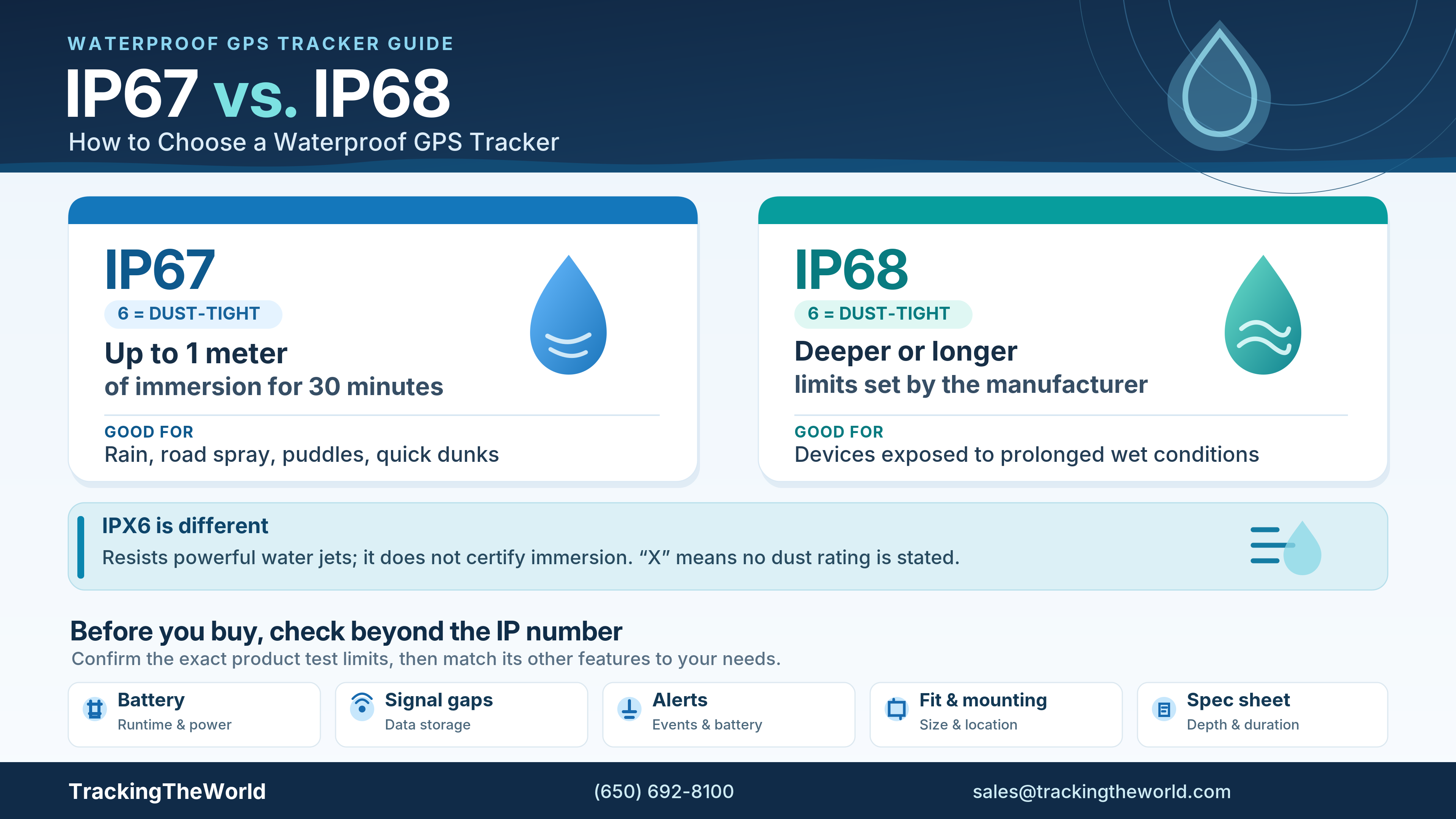
| IP67 | IP68 |
| Dust-tight (the 6 in the code) | Dust-tight (the 6 in the code) |
| Handles immersion in up to 1 meter of water for 30 minutes | Handles longer or deeper immersion, with the limits set by the maker |
| Fits rain, splashes, puddles, and quick dunks | Fits devices that may stay wet for a long time |
| Example: the AVL-75 4G vehicle tracker | Example: the CAT-200X 4G, listed as IP67 / IP68 |
What do IP67 and IP68 actually mean?
IP stands for ingress protection. The first digit rates protection against dust, and the second digit rates protection against water. A 6 in the first spot means the case is fully dust-tight. The 7 or 8 in the second spot tells you how much water the device can handle.
An IP67 device survives immersion in up to 1 meter of water for 30 minutes. An IP68 device survives longer or deeper immersion. The maker sets the exact depth and time, so always read the spec sheet before you decide.
Dust matters as much as water. Fine grit and mud can wear out seals over time. IP67 and IP68 share the same dust rating, so the water digit is the only difference between them.
Which rating fits your tracking job?
Match the rating to the amount of water your tracker will face. For most daily use, IP67 is enough. Choose IP68 when the tracker may stay wet for a long time. Here is how that plays out for common jobs:
- Vehicles and motorcycles: Rain and road spray last a short time. The AVL-75 4G is a waterproof GPS tracker that lists IP67 compliance, and it tracks both vehicles and motorcycles.
- People and pets: Showers, swimming, and storms test a wearable tracker. Our CAT-200X 4G is a waterproof GPS tracker listed as IP67 / IP68, and it tracks lone workers, elderly people, and pets.
- Trailers and heavy assets: Harsh outdoor use calls for a tougher device. We built the AVL-600W Series for trailer tracking in harsh, heavy environments, and its rechargeable internal battery gives 90 days of standby time.
Is water-resistant the same as waterproof?
No. Water-resistant is a looser term. It means a device handles some water, but it does not tell you how much. A waterproof claim backed by an IP number is easier to trust.
For example, we list the Enduro Plus 4G as water-resistant, and its page gives no IP rating. A case can close that gap. Our Pelican 1010 and 1020 cases are crushproof, dustproof, and watertight, and they follow IP67 test rules for 1 meter of water and 30 minutes. Both cases hold Enduro Plus devices that run on an external battery.
When you shop, look for the actual IP code on the product page. If you see only a general claim, ask the maker for the rating.
The MT-100 sits in the middle. We list it as water-resistant and IPX6-compliant. IPX6 covers powerful water jets, but it does not promise protection from immersion.
What else should you check before you buy?
A rating is only one piece of the puzzle. Check these points too:
- Battery: Look at the internal capacity and ask about external power. The Enduro Plus 4G has a 2600 mAh internal battery, and it can also connect to DC power or an external battery.
- Signal gaps: The CAT-200X 4G has a 64Mbit flash data logger, so it keeps location data in areas without GSM signal.
- Alerts: The CAT-200X 4G sends alarms for low battery, geo-fence crossings, over-speed, and belt off or on.
- Size: The AVL-75 4G measures 102 x 46 x 20.5 mm, so check that it fits your install spot.
- Mounting: Our Mini Mag cases hold Enduro devices and attach with a strong magnet, which suits many vehicle and asset installs.
- Network: Many of our trackers come in 4G versions, so you can match the device to your network.
Ready to compare models? Browse our full range of waterproof GPS tracker options, or call us and we will help you match a rating to your job.
Frequently Asked Questions
Is IP68 always better than IP67?
Not always. IP68 covers longer or deeper water exposure, but many jobs never need it. For rain, splashes, and quick dunks, IP67 does the work. Pick IP68 if the tracker may stay underwater.
Does an IP rating cover salt water or hot water?
Not necessarily. Makers test ratings in controlled lab conditions. Salt water, pool chemicals, and hot water can stress seals in other ways, so ask the maker before you use a tracker in those settings.
What does IPX6 mean?
IPX6 means the device resists powerful water jets. The X means the maker did not rate it for dust. IPX6 does not promise protection from immersion. Our MT-100 lists IPX6 compliance.
Which TrackingTheWorld trackers list a waterproof rating?
Several do. The AVL-75 4G lists IP67, and the CAT-65 4G and CAT-200X 4G list IP67 / IP68. The MT-100 lists IPX6, and the Enduro Plus line is water-resistant. Check each product page for the latest details.
Need help choosing? Call TrackingTheWorld at (650) 692-8100, email sales@trackingtheworld.com, or contact our team. We have focused on GPS tracking since 2003, and our office is at 2360 East Bidwell Street, Suite 111, Folsom, CA 95630.


Photo by anthonyintraversato on Pixabay
Some industries require that workers perform in a warehouse and some work out in the field. If you are someone who works alone, or you employ people who are on their own, it is always a good idea to use a lone worker GPS tracker. Being able to track the movements of an employee ensures you can find them in an emergency. It also helps to limit your liability should something go wrong.
What Is a Lone Worker GPS Tracker?
A lone worker GPS tracker is a device that an employee wears that provides other people with their coordinates. For some industries where dangerous situations can arise, they are highly critical. Even in non-dangerous jobs, they are an excellent way to limit liability. Should there ever be a question about an employee’s whereabouts, the tracker can go help trace them. It can provide the worker’s coordinates in real-time and show a record of their movements.
If Your Worker Goes Missing
If your worker is ever out in the field and they don’t check in, you can have the security of knowing where they are with GPS tracking. That way, you can send someone to find them and make sure that they are alright. Also, for liability issues, if your employer is injured on the job and there is a question about how or where it happened, a lone worker GPS tracker can supply you with proof to either approve or deny a workers’ compensation claim.
Clocking Employee Hours
For those workers who are unsupervised or work flexible hours, a lone worker GPS tracker can serve another purpose. Not only can it tell an employer where an employee is, but it can also serve as a time clock. A lone GPS tracker prevents workers from logging hours when they were not working. And, in the same respect, it gives workers the proof they need to show that they were on the job.
The Best Supervision Available for the Unsupervised
If you have an employee who works unsupervised, or if you are an employee who works off hours without your employer present, it is an excellent idea to have a lone worker GPS tracker. It limits any question about whether the worker was where they said, and also it can help to find someone in an emergency. A lone worker GPS tracker is imperative for any employer/employee to limit both questions of someone’s hours and liability. Check out all the GPS tracking devices available at Tracking the World to ensure that your workers are safe when they have to go solo.


