A tracker that fails in the rain is not much use. That is why every waterproof GPS tracker needs a real rating, not just a promise on the box. Two ratings come up again and again: IP67 and IP68. They look almost the same, but they are not. In this guide, we explain the difference, show where each rating fits, and list what to check before you buy.
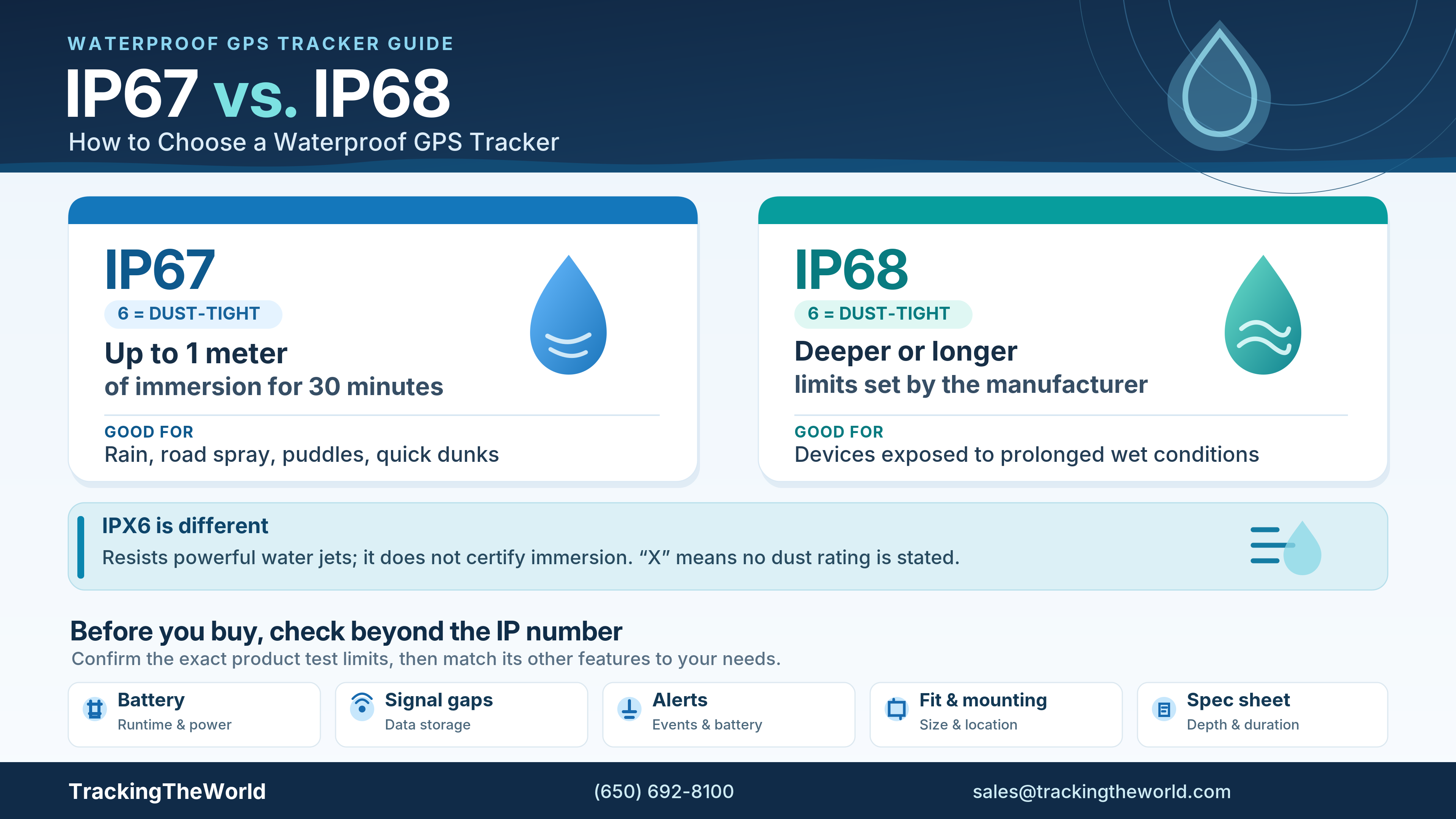
| IP67 | IP68 |
| Dust-tight (the 6 in the code) | Dust-tight (the 6 in the code) |
| Handles immersion in up to 1 meter of water for 30 minutes | Handles longer or deeper immersion, with the limits set by the maker |
| Fits rain, splashes, puddles, and quick dunks | Fits devices that may stay wet for a long time |
| Example: the AVL-75 4G vehicle tracker | Example: the CAT-200X 4G, listed as IP67 / IP68 |
What do IP67 and IP68 actually mean?
IP stands for ingress protection. The first digit rates protection against dust, and the second digit rates protection against water. A 6 in the first spot means the case is fully dust-tight. The 7 or 8 in the second spot tells you how much water the device can handle.
An IP67 device survives immersion in up to 1 meter of water for 30 minutes. An IP68 device survives longer or deeper immersion. The maker sets the exact depth and time, so always read the spec sheet before you decide.
Dust matters as much as water. Fine grit and mud can wear out seals over time. IP67 and IP68 share the same dust rating, so the water digit is the only difference between them.
Which rating fits your tracking job?
Match the rating to the amount of water your tracker will face. For most daily use, IP67 is enough. Choose IP68 when the tracker may stay wet for a long time. Here is how that plays out for common jobs:
- Vehicles and motorcycles: Rain and road spray last a short time. The AVL-75 4G is a waterproof GPS tracker that lists IP67 compliance, and it tracks both vehicles and motorcycles.
- People and pets: Showers, swimming, and storms test a wearable tracker. Our CAT-200X 4G is a waterproof GPS tracker listed as IP67 / IP68, and it tracks lone workers, elderly people, and pets.
- Trailers and heavy assets: Harsh outdoor use calls for a tougher device. We built the AVL-600W Series for trailer tracking in harsh, heavy environments, and its rechargeable internal battery gives 90 days of standby time.
Is water-resistant the same as waterproof?
No. Water-resistant is a looser term. It means a device handles some water, but it does not tell you how much. A waterproof claim backed by an IP number is easier to trust.
For example, we list the Enduro Plus 4G as water-resistant, and its page gives no IP rating. A case can close that gap. Our Pelican 1010 and 1020 cases are crushproof, dustproof, and watertight, and they follow IP67 test rules for 1 meter of water and 30 minutes. Both cases hold Enduro Plus devices that run on an external battery.
When you shop, look for the actual IP code on the product page. If you see only a general claim, ask the maker for the rating.
The MT-100 sits in the middle. We list it as water-resistant and IPX6-compliant. IPX6 covers powerful water jets, but it does not promise protection from immersion.
What else should you check before you buy?
A rating is only one piece of the puzzle. Check these points too:
- Battery: Look at the internal capacity and ask about external power. The Enduro Plus 4G has a 2600 mAh internal battery, and it can also connect to DC power or an external battery.
- Signal gaps: The CAT-200X 4G has a 64Mbit flash data logger, so it keeps location data in areas without GSM signal.
- Alerts: The CAT-200X 4G sends alarms for low battery, geo-fence crossings, over-speed, and belt off or on.
- Size: The AVL-75 4G measures 102 x 46 x 20.5 mm, so check that it fits your install spot.
- Mounting: Our Mini Mag cases hold Enduro devices and attach with a strong magnet, which suits many vehicle and asset installs.
- Network: Many of our trackers come in 4G versions, so you can match the device to your network.
Ready to compare models? Browse our full range of waterproof GPS tracker options, or call us and we will help you match a rating to your job.
Frequently Asked Questions
Is IP68 always better than IP67?
Not always. IP68 covers longer or deeper water exposure, but many jobs never need it. For rain, splashes, and quick dunks, IP67 does the work. Pick IP68 if the tracker may stay underwater.
Does an IP rating cover salt water or hot water?
Not necessarily. Makers test ratings in controlled lab conditions. Salt water, pool chemicals, and hot water can stress seals in other ways, so ask the maker before you use a tracker in those settings.
What does IPX6 mean?
IPX6 means the device resists powerful water jets. The X means the maker did not rate it for dust. IPX6 does not promise protection from immersion. Our MT-100 lists IPX6 compliance.
Which TrackingTheWorld trackers list a waterproof rating?
Several do. The AVL-75 4G lists IP67, and the CAT-65 4G and CAT-200X 4G list IP67 / IP68. The MT-100 lists IPX6, and the Enduro Plus line is water-resistant. Check each product page for the latest details.
Need help choosing? Call TrackingTheWorld at (650) 692-8100, email sales@trackingtheworld.com, or contact our team. We have focused on GPS tracking since 2003, and our office is at 2360 East Bidwell Street, Suite 111, Folsom, CA 95630.
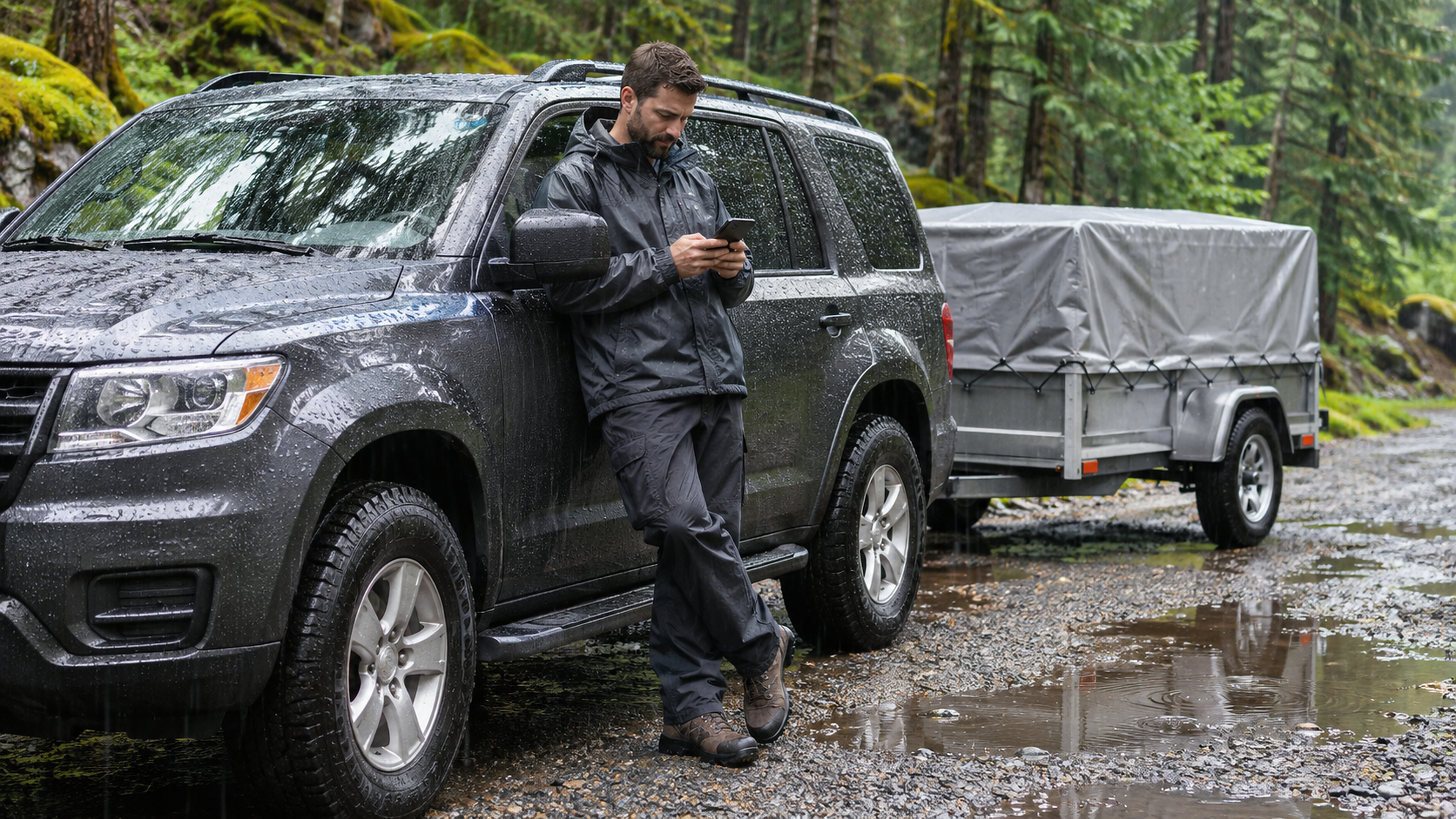


Planning a group excursion involves massive logistical headaches. You have to coordinate bathroom breaks, manage transport schedules, and somehow keep an eye on energetic kids or wandering adults. One person lags behind to tie a shoe, and suddenly your whole group dynamic fractures. Utilizing GPS tracking for family trips and outdoor adventures allows trip coordinators and parents to monitor exact coordinates in real time.
Safety should not rely on a headcount every five minutes. Modern satellite hardware offers a far more reliable safety net than frantic shouting in crowded parks or dense forests. Investing in robust personal and vehicle GPS tracking for families converts chaotic supervision into a structured, highly visible operation.
| Excursion Type | Primary Tracking Risk | Ideal Hardware Feature | Recommended Hardware Setup |
| Family Road Trips | Vehicle breakdown in zero-cell zones | Hardwired OBD connection with internal backup power | Vehicle tracking with live map-sharing capabilities |
| Wilderness Hiking | Dense canopy blocking standard signals | High-sensitivity GPS modules with AGPS positioning | Compact portable trackers hidden securely in backpacks |
| School Field Trips | Rapidly moving children in crowds | Compact, lightweight multi-purpose portable trackers | Real-time geofencing and active text warning alerts |
Selecting the correct tracking system requires understanding your specific environment. A cheap smartphone application is completely useless the moment cellular towers vanish past the mountain ridge. Professional-grade family travel GPS tracking solutions rely on dedicated hardware built to survive impact, moisture, and prolonged battery drain.
Why Is Cellular Phone Tracking Insufficient for Wilderness Environments?
Bottom Line Up Front: Cellular phone tracking fails in deep wilderness because phones often rely on nearby terrestrial towers. Dedicated GPS trackers communicate directly with overhead satellite networks and store internal coordinates when connectivity drops, ensuring continuous history updates even in total dead zones.
Smartphones are magnificent tools for urban navigation, but they fail miserably as emergency lifelines. A phone actively scanning for weak cellular signals drains its internal battery within a few hours. Furthermore, phone screens crack easily during minor falls on rocky trails.
Dedicated satellite trackers operate on entirely different engineering principles. These units use optimized protocols that conserve energy by transmitting data in precise bursts. Many models feature power conservation triggers that put the device to sleep when no motion is detected, serving as indispensable GPS trackers for family travel safety.
Consider these distinct technical advantages of dedicated hardware:
- Ruggedized Enclosures: Professional devices feature high water-resistance ratings and drop-proof cases to survive heavy rain, thick mud, and deep puddles.
- Data Logging Memory: When dense tree canopies or canyon walls block all signals, internal memory chips save your historical breadcrumb trail until the sky clears.
- Long Standby Power: Internal battery architecture allows small portable units to operate reliably for days without needing a wall charger.
How Does Satellite Hardware Enhance School Field Trip Supervision?
Bottom Line Up Front: GPS hardware streamlines field trip supervision by establishing virtual boundaries around specific event spaces. Chaperones receive instant automated text messages if a student wanders outside the designated zone, enabling immediate intervention before a child becomes truly lost.
Amusement parks and crowded museums are absolute nightmares for school teachers. A class of thirty children can scatter in a dozen different directions in a matter of seconds. Relying on physical chaperones to watch every single exit point is a losing battle.
Placing a compact GPS tracker for kids’ hiking and field trips into a student’s backpack fundamentally changes the safety dynamic. Instructors can look at a single mobile dashboard to view the entire group spread across a property. This eliminates the panic of a mismatched headcount during transitions.
Our clients deploy tracking hardware during large-scale student excursions to manage these specific challenges:
- Managing Arrival Windows: Remote dispatchers track bus locations to give school administrators exact arrival updates.
- Optimizing Chaperone Placement: Managers see which areas of a park have the highest concentration of students.
- Streamlining Emergency Responses: If a medical emergency occurs, coordinators locate the nearest staff member instantly.
Implementing professional GPS tracking for family trips and outdoor adventures and dedicated GPS safety tracking for school field trips transforms how institutions approach child safety during off-site travel.
Dual-Layer Protection: Seamless Vehicle and Personal Tracking Integration
Comprehensive travel protection requires a combination of robust vehicle monitoring and portable personal hardware. By combining specialized devices, families can maintain total situational awareness whether they are driving on a remote highway or exploring on foot.
True safety requires an ecosystem that covers both the journey and the destination. Rather than relying on a single piece of hardware to do everything, deploying specialized tools ensures that your real-time GPS tracking for family adventures functions flawlessly across all terrains.
Dedicated Highway Asset Security: The GV53MG
Your safety network begins the moment you back out of the driveway. Deploying a specialized vehicle GPS tracker for family vacations, such as the Tracking the World GV53MG, allows you to maintain constant tabs on your car, truck, or RV. The GV53MG hardwires seamlessly into your vehicle’s power supply, featuring an internal battery backup for continuous data transmission.
When you use the GV53MG to track the vehicle, extended family or friends back home can follow along by sharing the tracking map to see all the unique places visited. More importantly, this map sharing acts as an essential safety measure if something happens—such as an engine breakdown or an accident in an isolated location—ensuring emergency services know exactly where to dispatch assistance.
Portable Wilderness Tracking Protection: The GL320MG
The safety net shouldn’t vanish when you park the car. For on-foot excursions, the compact GL320MG portable tracker serves as your individual lifeline. This lightweight, highly rugged device is built to slip effortlessly into small pockets or gear pouches.
The GL320MG can be put inside a backpack when going hiking or backpacking, or carried along as you stroll around town, navigate crowded amusement parks, and explore busy city centers. This ensures that no matter how far your family wanders from the vehicle, their exact latitude and longitude remain visible on your private monitoring dashboard, creating premium, multi-layered family travel GPS tracking solutions.
What Features Matter Most When Choosing an Outdoor Tracker?
Outdoor trackers require exceptional battery life, rapid ping frequencies, and robust water resistance. Devices must also feature configurable alert triggers, such as geofencing boundaries and motion sensors, to keep coordinators informed without constant manual monitoring.
Do not buy a tracking device based solely on a low price tag. A tracker that stops working after a minor rainstorm is a liability, not an asset. Look for devices that offer universal protocol support and flexible mounting options to secure reliable GPS safety tracking for family adventures.
Battery capacity dictates your operational limits. If your family plans a four-day backpacking trip, a tracker with a tiny battery will die before you reach the second campsite. Many professional setups allow you to connect external battery packs or hardwire the system to a vehicle supply line.
Hardware must balance these critical technical attributes:
- Ping Frequency Control: Look for software that lets you adjust tracking intervals from every thirty seconds during active hiking to hourly when at camp.
- High-Gain Antennas: Internal antennas must be sensitive enough to capture satellite signals even from inside a backpack or glove box.
- Emergency Alert Integration: Devices should include a physical button that users can press to send an immediate distress notification.
How Do You Deploy Geofencing for Family Excursions?
Geofencing allows you to draw digital parameters around your campsite, hotel, or trail map. The tracking software monitors device locations against these digital borders and fires an automated text notification the instant a family member crosses the line.
Geofencing acts as an invisible, silent perimeter guard for your loved ones. If you are camping near a dangerous river, you can draw a custom boundary between your tents and the water line. You can sleep soundly knowing the software is monitoring the perimeter.
This feature is equally valuable for teenage drivers on family road trips. You can set alerts for excessive speed or unauthorized detours away from the main highway route. It creates a clear culture of accountability behind the wheel, solidifying effective GPS tracking for family trips and outdoor adventures.
Effective geofencing deployments utilize these best practices:
- Custom Boundary Shapes: Use polygonal borders to trace exact trail lines rather than simple standard circles.
- Time-Based Restrictions: Activate specific curfew triggers that alert you if a vehicle moves after midnight.
- Multi-User Notifications: Route critical alerts to multiple phones so someone always sees the warning immediately.
Using advanced hardware handles the hard work of group coordination, giving you complete control over your surroundings during intensive GPS tracking for family vacations and field trips.
Frequently Asked Questions
Can I monitor these tracking devices from my own smartphone?
Yes, modern tracking platforms offer full mobile compatibility. You can view live asset positions, edit geofence boundaries, and receive instant alert notifications directly through a standard web browser or dedicated app on your phone.
Do these devices require clear line-of-sight to the sky to function?
While a clear view of the sky provides the highest precision, high-quality hardware utilizes advanced positioning technologies to maintain locks. If a signal drops completely inside a thick building or tunnel, the device logs data internally until connectivity returns.
How do I ensure the tracker does not get damaged by bad weather?
You should select devices that feature heavy-duty waterproof housings, or place your portable trackers inside specialized protective cases. Accessories like custom magnet cases protect internal components from dust, rain, and mud.
Is it possible to use these systems to track both vehicles and individuals?
Multi-purpose trackers are designed specifically for this type of flexibility. You can slip a portable unit into a hiker’s pocket during the day, and then connect it to a vehicle power source for asset tracking at night.
Managing group logistics in remote areas does not have to be a guessing game. Stop relying on spotty cell service and unpredictable headcounts to keep your family or students safe. Reach out to the expert team at Tracking The World to build a reliable satellite safety net for your upcoming journeys. Explore our comprehensive selection of professional-grade hardware or secure a tailored quote by calling our office directly at (650) 692-8100. You can also connect with our tech team by emailing sales@trackingtheworld.com to discover the exact tracking configuration for your lifestyle. Let us help you convert data into complete peace of mind on every trail, highway, and field trip.


Managing a fleet of vehicles is a complex task for any company. You must handle high fuel costs, driver safety, and tight schedules all at once. Fortunately, modern technology offers a powerful way to streamline these operations. Using GPS tracking for businesses allows you to see exactly what is happening on the road in real time.
This transparency changes everything for a fleet manager. You no longer have to guess where your drivers are or how they’re handling your assets. Instead, you have solid data to make better decisions. This guide explores why implementing a tracking system is a true game-changer for your bottom line.
Enhancing Operational Efficiency and Productivity
The most immediate benefit of tracking is the boost in daily efficiency. When you can see every vehicle on a live map, you can dispatch the closest driver to a new job. This reduces travel time and allows your team to complete more tasks in a single shift.
Furthermore, GPS tracking for businesses helps you eliminate unauthorized stops. Drivers are more likely to stay on task when they know the system records their location. This accountability ensures that your company time is spent on company business. Consequently, your overall productivity rises without the need to hire more staff.
Reducing Fuel Costs and Idle Time
Fuel is often the largest expense for any fleet. However, tracking software gives you the tools to fight rising gas prices. By monitoring idle times, you can identify drivers who leave engines running unnecessarily. Excessive idling wastes a surprising amount of fuel over a month.
In addition, smart routing helps your drivers avoid heavy traffic and long detours. Better routes mean fewer miles driven and less wear on the vehicle. Because the software provides real-time traffic updates, your fleet can navigate around delays before they happen. These small daily savings add up to significant capital at the end of the year.
Improving Driver Safety and Habits
Safety is a top priority for any professional organization. A tracking system acts as a digital co-pilot that monitors driver behavior. You can receive instant alerts for several risky actions, such as:
-
High-speed driving over the limit
-
Sudden or harsh braking
-
Rapid acceleration from a stop
When you address these behaviors, you lower the risk of accidents. This protects your employees and reduces your liability. Moreover, safer driving habits lead to lower insurance premiums over time. Most providers appreciate the reduced risk that comes with GPS tracking for businesses.
Streamlining Maintenance and Vehicle Health
Unexpected breakdowns can ruin a busy workday. To prevent this, many businesses use tracking hardware to stay ahead of repairs. Some devices plug directly into the vehicle’s computer to read diagnostic codes. This allows the software to notify you when a “check engine” light is about to trigger.
By staying on top of preventative maintenance, you extend the life of your fleet. You can schedule oil changes and tire rotations based on actual mileage tracked by the system. This proactive approach ensures your vehicles stay on the road instead of sitting in a repair shop.
Boosting Customer Satisfaction
In today’s fast-paced world, customers expect transparency. If a client asks where their delivery is, you can give them an exact answer. Many fleet tracking systems even allow you to share a temporary “live link” with the customer. This shows them the vehicle’s progress in real time.
When you provide accurate arrival times, you build trust with your clients. This professional level of service sets you apart from competitors who still rely on “ballpark” estimates. Happy customers are more likely to return and recommend your services to others.
Asset Security and Theft Recovery
Theft is a constant threat to mobile businesses. However, GPS tracking for businesses provides a powerful safety net. If a vehicle or a piece of heavy equipment is moved without permission, you will know immediately. You can set up “geofences” around your parking lot or job sites. If an asset leaves that area after hours, the system sends an urgent alert to your phone.
In the event of a theft, you can provide live location data to the police. This makes recovery much faster and more likely. It also prevents the total loss of expensive equipment that is difficult to replace.
Data-Driven Decision Making
The true power of a GPS system lies in the reports it generates. You can look back at weeks or months of data to find trends. Perhaps certain routes are always slower on Tuesdays, or a specific vehicle is using more fuel than others.
These insights allow you to manage your business with facts rather than feelings. You can see exactly where your money is going and where you can cut waste. This data-driven approach is what allows small businesses to scale into large, successful fleets.
Choosing the Right System for Your Company
Every business has different needs when it comes to hardware. Some companies prefer simple plug-and-play devices for light-duty trucks. Others need rugged, weatherproof trackers for trailers or construction equipment. When you choose a provider, look for a platform that is easy to use and offers 24/7 support.
Consider the following when selecting your gear:
-
Update Rates: Do you need updates every ten seconds or every five minutes?
-
Mobile Access: Can you check the fleet from a smartphone app while on the go?
-
Scalability: Will the software grow with you as you add more vehicles?
The Future of Fleet Intelligence
Technology is moving faster than ever. Modern tracking systems are now integrating with AI to predict maintenance needs and even safer routes. By adopting these tools now, you prepare your business for the future. You gain a competitive edge that helps you stay profitable in a tough market.
The transparency provided by GPS tracking for businesses is no longer a luxury. It is a vital tool for any company that operates vehicles. It protects your assets, saves you money, and keeps your team safe. When you have the right data, you have the power to lead your industry.
Partner with Tracking the World
Are you ready to transform your business operations? Tracking the World offers a wide range of professional GPS solutions designed specifically for fleet management. We provide the hardware and the software you need to take full control of your mobile assets. Our systems are reliable, easy to install, and packed with the features that modern business owners demand.
Contact us today to learn how we can help you save money and improve safety. Let us show you why our tracking technology is the perfect fit for your growing fleet.


