A tracker that fails in the rain is not much use. That is why every waterproof GPS tracker needs a real rating, not just a promise on the box. Two ratings come up again and again: IP67 and IP68. They look almost the same, but they are not. In this guide, we explain the difference, show where each rating fits, and list what to check before you buy.
| IP67 | IP68 |
| Dust-tight (the 6 in the code) | Dust-tight (the 6 in the code) |
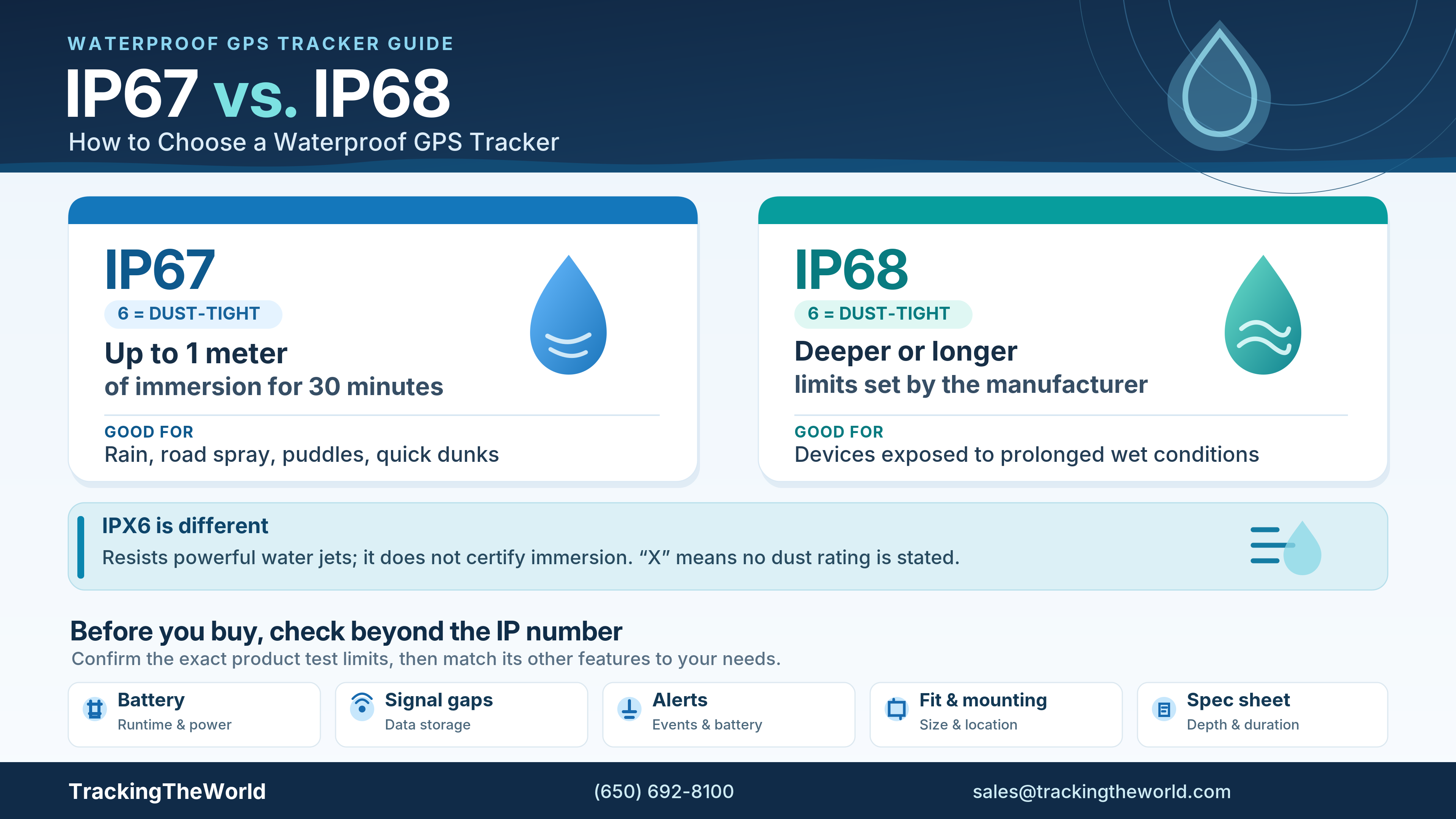
| Handles immersion in up to 1 meter of water for 30 minutes | Handles longer or deeper immersion, with the limits set by the maker |
| Fits rain, splashes, puddles, and quick dunks | Fits devices that may stay wet for a long time |
| Example: the AVL-75 4G vehicle tracker | Example: the CAT-200X 4G, listed as IP67 / IP68 |
What do IP67 and IP68 actually mean?
IP stands for ingress protection. The first digit rates protection against dust, and the second digit rates protection against water. A 6 in the first spot means the case is fully dust-tight. The 7 or 8 in the second spot tells you how much water the device can handle.
An IP67 device survives immersion in up to 1 meter of water for 30 minutes. An IP68 device survives longer or deeper immersion. The maker sets the exact depth and time, so always read the spec sheet before you decide.
Dust matters as much as water. Fine grit and mud can wear out seals over time. IP67 and IP68 share the same dust rating, so the water digit is the only difference between them.
Which rating fits your tracking job?
Match the rating to the amount of water your tracker will face. For most daily use, IP67 is enough. Choose IP68 when the tracker may stay wet for a long time. Here is how that plays out for common jobs:
- Vehicles and motorcycles: Rain and road spray last a short time. The AVL-75 4G is a waterproof GPS tracker that lists IP67 compliance, and it tracks both vehicles and motorcycles.
- People and pets: Showers, swimming, and storms test a wearable tracker. Our CAT-200X 4G is a waterproof GPS tracker listed as IP67 / IP68, and it tracks lone workers, elderly people, and pets.
- Trailers and heavy assets: Harsh outdoor use calls for a tougher device. We built the AVL-600W Series for trailer tracking in harsh, heavy environments, and its rechargeable internal battery gives 90 days of standby time.
Is water-resistant the same as waterproof?
No. Water-resistant is a looser term. It means a device handles some water, but it does not tell you how much. A waterproof claim backed by an IP number is easier to trust.
For example, we list the Enduro Plus 4G as water-resistant, and its page gives no IP rating. A case can close that gap. Our Pelican 1010 and 1020 cases are crushproof, dustproof, and watertight, and they follow IP67 test rules for 1 meter of water and 30 minutes. Both cases hold Enduro Plus devices that run on an external battery.
When you shop, look for the actual IP code on the product page. If you see only a general claim, ask the maker for the rating.
The MT-100 sits in the middle. We list it as water-resistant and IPX6-compliant. IPX6 covers powerful water jets, but it does not promise protection from immersion.
What else should you check before you buy?
A rating is only one piece of the puzzle. Check these points too:
- Battery: Look at the internal capacity and ask about external power. The Enduro Plus 4G has a 2600 mAh internal battery, and it can also connect to DC power or an external battery.
- Signal gaps: The CAT-200X 4G has a 64Mbit flash data logger, so it keeps location data in areas without GSM signal.
- Alerts: The CAT-200X 4G sends alarms for low battery, geo-fence crossings, over-speed, and belt off or on.
- Size: The AVL-75 4G measures 102 x 46 x 20.5 mm, so check that it fits your install spot.
- Mounting: Our Mini Mag cases hold Enduro devices and attach with a strong magnet, which suits many vehicle and asset installs.
- Network: Many of our trackers come in 4G versions, so you can match the device to your network.
Ready to compare models? Browse our full range of waterproof GPS tracker options, or call us and we will help you match a rating to your job.
Frequently Asked Questions
Is IP68 always better than IP67?
Not always. IP68 covers longer or deeper water exposure, but many jobs never need it. For rain, splashes, and quick dunks, IP67 does the work. Pick IP68 if the tracker may stay underwater.
Does an IP rating cover salt water or hot water?
Not necessarily. Makers test ratings in controlled lab conditions. Salt water, pool chemicals, and hot water can stress seals in other ways, so ask the maker before you use a tracker in those settings.
What does IPX6 mean?
IPX6 means the device resists powerful water jets. The X means the maker did not rate it for dust. IPX6 does not promise protection from immersion. Our MT-100 lists IPX6 compliance.
Which TrackingTheWorld trackers list a waterproof rating?
Several do. The AVL-75 4G lists IP67, and the CAT-65 4G and CAT-200X 4G list IP67 / IP68. The MT-100 lists IPX6, and the Enduro Plus line is water-resistant. Check each product page for the latest details.
Need help choosing? Call TrackingTheWorld at (650) 692-8100, email sales@trackingtheworld.com, or contact our team. We have focused on GPS tracking since 2003, and our office is at 2360 East Bidwell Street, Suite 111, Folsom, CA 95630.
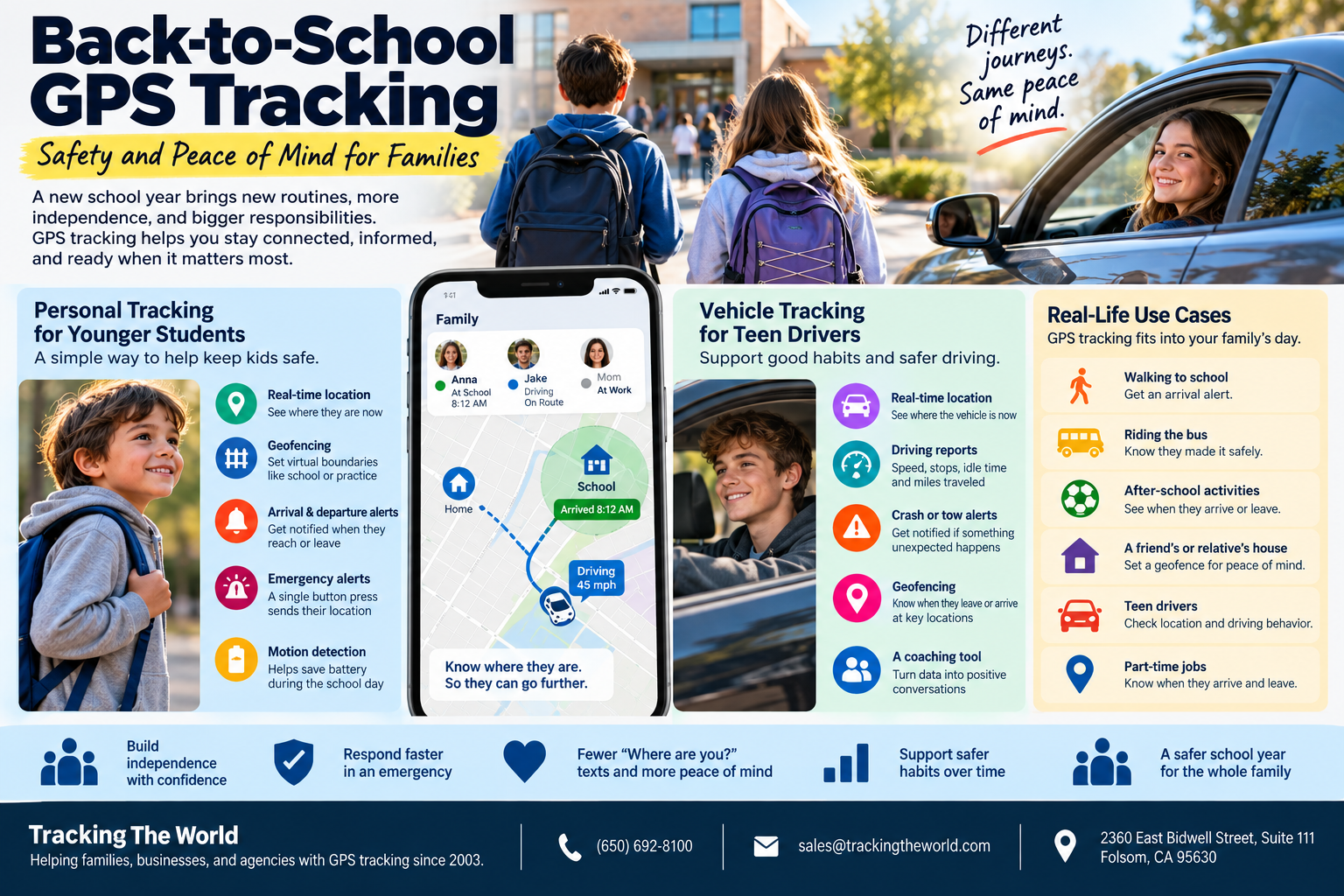
Back-to-School GPS Tracking Options
A new school year means new routines. Younger kids may start walking to school or riding the bus on their own for the first time. Teens with a brand-new license start driving themselves to class, practice, and part-time jobs. That independence is a good thing, but it also leaves a lot of parents wondering whether everyone got where they were supposed to go. A good back-to-school GPS tracking plan gives families a simple way to answer that question without a steady stream of “Where are you?” texts.
| Without GPS Tracking | With GPS Tracking |
|---|---|
| Guessing whether your child made it to school | An arrival alert when they reach school |
| Calling or texting a teen driver to check in | Checking the car’s location on a map |
| No record of how the family car is driven | Reports on speed, stops, and driving behavior |
| Hoping a child can make a phone call in an emergency | A single button press that sends an emergency alert |
| Worrying through practices and after-school plans | Notice when they leave or arrive at a set location |
What does GPS tracking do for students and parents?
It tells you where your child or your family vehicle is, and it alerts you when something needs your attention. A real-time tracker reports its location at set intervals, from every few seconds to every few hours, and you view it on a street-level map through GPS tracking software.
With back-to-school GPS tracking, parents can typically use:
- Real-time location: see where the tracker is right now, not just where it was earlier.
- Geofencing: draw a virtual boundary around a place, such as school or a practice field.
- Arrival and departure alerts: get notified when the tracker crosses one of those boundaries.
- Emergency alerts: on supported devices, a button press sends an alert right away.
- Driving reports: for vehicles, information such as speed, stops, idle time, and miles traveled.
Which students benefit from a personal GPS tracker?
A personal tracker makes the most sense for younger students who spend part of the day away from their parents and are not driving yet. Common situations include kids who:
- Walk or bike to school
- Ride the school bus
- Go to after-school programs, sports, or lessons
- Spend afternoons at a friend’s or relative’s house
Our multi-purpose trackers are compact, water-resistant, and small enough for a backpack pocket. A built-in button can send an emergency alert, with feedback so your child knows it went through. Motion detection also saves battery while the device sits still during class.
How does a vehicle GPS tracker help parents of teen drivers?
A vehicle tracker shows where the car goes and how it is being driven, which is what most parents of new drivers want to know.
It can help you:
- Confirm your teen got to school, work, or practice
- Review speed and stops after a trip
- Spot driving habits worth talking about, like hard driving patterns
- Get alerts if the car is involved in a crash or is being towed (on supported models)
Some of our vehicle trackers plug straight into a car’s OBDII port, so setup takes no wiring. Treat the reports as a coaching tool. A calm talk about a speeding report goes further than a lecture based on guesswork.
How do geofencing and emergency alerts work?
Geofencing lets you set boundaries around places that matter, and the system alerts you when the tracker enters or leaves them. For example, you might set geofences around:
- Your child’s school
- The practice field or gym
- A grandparent’s house
- Your teen’s workplace
You then get a notice when your child reaches school or your teen leaves work at night. Some of our devices can also set a geofence instantly at their current location, which is handy for a one-time meeting spot. If your child presses the emergency button, you are notified right away along with their location.
How can parents use GPS tracking without making kids feel watched?
The key is being open about it. Tracking works best when kids know it is there and understand why. A few habits help:
- Tell your child about the tracker before they use it
- Explain that it is about safety, not suspicion
- Lean on alerts rather than checking the map all day
- Agree on house rules, such as when location will be checked
- Loosen things up as your child shows more responsibility
Used this way, back-to-school GPS tracking becomes a shared safety net. Plenty of teens like knowing a parent can find them fast if the car breaks down.
Should you choose a personal tracker or a vehicle tracker?
It comes down to who is on the move and how they get around. Here is a simple way to think about it:
- Choose a personal tracker if your child walks, bikes, rides the bus, or needs an emergency button.
- Choose a vehicle tracker if your teen drives and you want speed and driving-behavior reports.
- Consider both if you have a younger student and a teen driver in the same household.
If you are not sure, our team can talk through your family’s routine and point you to the right fit for back-to-school GPS tracking.
Frequently Asked Questions
Is GPS tracking only for young children?
No. Personal trackers suit younger students, and vehicle trackers are built for teen drivers. Many families use one of each.
Do GPS trackers require a subscription?
Real-time trackers rely on a subscription-based tracking service to send location data you can view. That service is what makes live maps and alerts possible. Our sales team can explain the options when you contact us.
Can I get an alert when my child arrives at school?
Yes. By setting a geofence around the school, you can receive a notice when the tracker arrives or leaves. The same works for practices or jobs.
How much does a tracker cost?
Cost depends on the device and service plan that fits your family. Contact our sales team for current details and a recommendation based on your needs.
TrackingTheWorld has been helping families, businesses, and agencies with GPS tracking since 2003. To find the right tracker before the school year gets busy, call our sales team at (650) 692-8100, email sales@trackingtheworld.com, or reach us through our contact page. Our office is located at 2360 East Bidwell Street, Suite 111, Folsom, CA 95630.


