Back-to-School GPS Tracking Options
A new school year means new routines. Younger kids may start walking to school or riding the bus on their own for the first time. Teens with a brand-new license start driving themselves to class, practice, and part-time jobs. That independence is a good thing, but it also leaves a lot of parents wondering whether everyone got where they were supposed to go. A good back-to-school GPS tracking plan gives families a simple way to answer that question without a steady stream of “Where are you?” texts.
| Without GPS Tracking | With GPS Tracking |
|---|---|
| Guessing whether your child made it to school | An arrival alert when they reach school |
| Calling or texting a teen driver to check in | Checking the car’s location on a map |
| No record of how the family car is driven | Reports on speed, stops, and driving behavior |
| Hoping a child can make a phone call in an emergency | A single button press that sends an emergency alert |
| Worrying through practices and after-school plans | Notice when they leave or arrive at a set location |
What does GPS tracking do for students and parents?
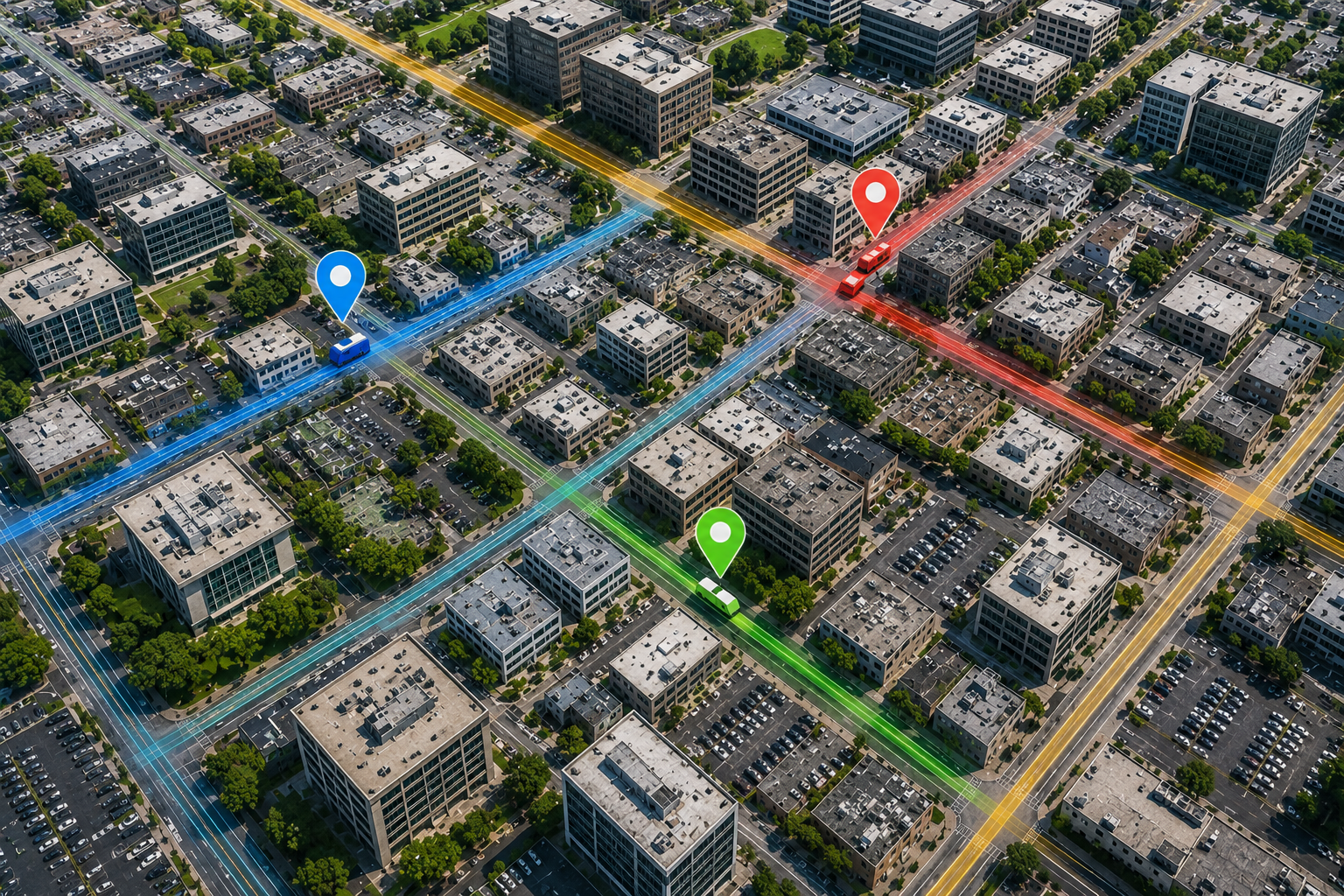
It tells you where your child or your family vehicle is, and it alerts you when something needs your attention. A real-time tracker reports its location at set intervals, from every few seconds to every few hours, and you view it on a street-level map through GPS tracking software.
With back-to-school GPS tracking, parents can typically use:
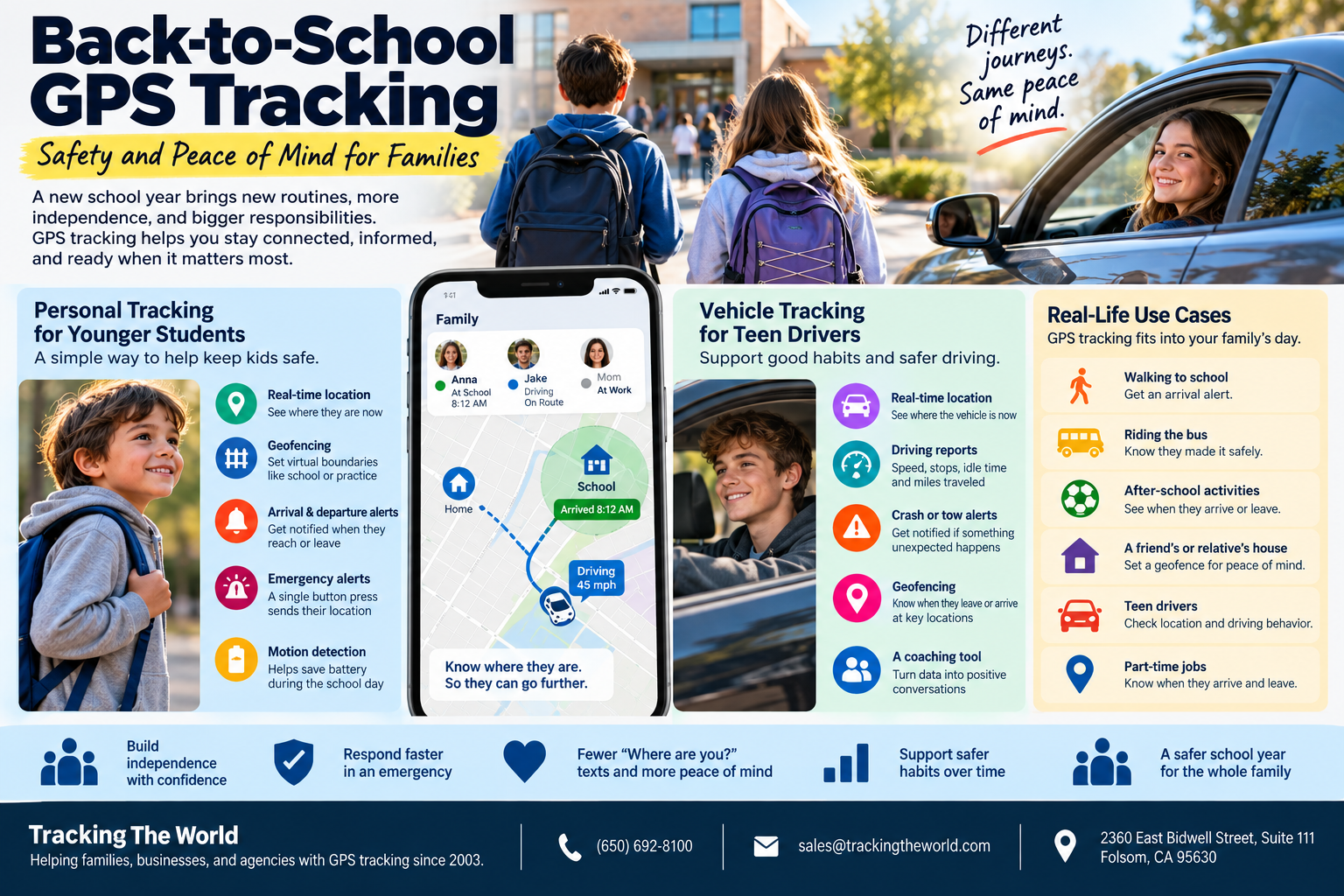
- Real-time location: see where the tracker is right now, not just where it was earlier.
- Geofencing: draw a virtual boundary around a place, such as school or a practice field.
- Arrival and departure alerts: get notified when the tracker crosses one of those boundaries.
- Emergency alerts: on supported devices, a button press sends an alert right away.
- Driving reports: for vehicles, information such as speed, stops, idle time, and miles traveled.
Which students benefit from a personal GPS tracker?
A personal tracker makes the most sense for younger students who spend part of the day away from their parents and are not driving yet. Common situations include kids who:
- Walk or bike to school
- Ride the school bus
- Go to after-school programs, sports, or lessons
- Spend afternoons at a friend’s or relative’s house
Our multi-purpose trackers are compact, water-resistant, and small enough for a backpack pocket. A built-in button can send an emergency alert, with feedback so your child knows it went through. Motion detection also saves battery while the device sits still during class.
How does a vehicle GPS tracker help parents of teen drivers?
A vehicle tracker shows where the car goes and how it is being driven, which is what most parents of new drivers want to know.
It can help you:
- Confirm your teen got to school, work, or practice
- Review speed and stops after a trip
- Spot driving habits worth talking about, like hard driving patterns
- Get alerts if the car is involved in a crash or is being towed (on supported models)
Some of our vehicle trackers plug straight into a car’s OBDII port, so setup takes no wiring. Treat the reports as a coaching tool. A calm talk about a speeding report goes further than a lecture based on guesswork.
How do geofencing and emergency alerts work?
Geofencing lets you set boundaries around places that matter, and the system alerts you when the tracker enters or leaves them. For example, you might set geofences around:
- Your child’s school
- The practice field or gym
- A grandparent’s house
- Your teen’s workplace
You then get a notice when your child reaches school or your teen leaves work at night. Some of our devices can also set a geofence instantly at their current location, which is handy for a one-time meeting spot. If your child presses the emergency button, you are notified right away along with their location.
How can parents use GPS tracking without making kids feel watched?
The key is being open about it. Tracking works best when kids know it is there and understand why. A few habits help:
- Tell your child about the tracker before they use it
- Explain that it is about safety, not suspicion
- Lean on alerts rather than checking the map all day
- Agree on house rules, such as when location will be checked
- Loosen things up as your child shows more responsibility
Used this way, back-to-school GPS tracking becomes a shared safety net. Plenty of teens like knowing a parent can find them fast if the car breaks down.
Should you choose a personal tracker or a vehicle tracker?
It comes down to who is on the move and how they get around. Here is a simple way to think about it:
- Choose a personal tracker if your child walks, bikes, rides the bus, or needs an emergency button.
- Choose a vehicle tracker if your teen drives and you want speed and driving-behavior reports.
- Consider both if you have a younger student and a teen driver in the same household.
If you are not sure, our team can talk through your family’s routine and point you to the right fit for back-to-school GPS tracking.
Frequently Asked Questions
Is GPS tracking only for young children?
No. Personal trackers suit younger students, and vehicle trackers are built for teen drivers. Many families use one of each.
Do GPS trackers require a subscription?
Real-time trackers rely on a subscription-based tracking service to send location data you can view. That service is what makes live maps and alerts possible. Our sales team can explain the options when you contact us.
Can I get an alert when my child arrives at school?
Yes. By setting a geofence around the school, you can receive a notice when the tracker arrives or leaves. The same works for practices or jobs.
How much does a tracker cost?
Cost depends on the device and service plan that fits your family. Contact our sales team for current details and a recommendation based on your needs.
TrackingTheWorld has been helping families, businesses, and agencies with GPS tracking since 2003. To find the right tracker before the school year gets busy, call our sales team at (650) 692-8100, email sales@trackingtheworld.com, or reach us through our contact page. Our office is located at 2360 East Bidwell Street, Suite 111, Folsom, CA 95630.
.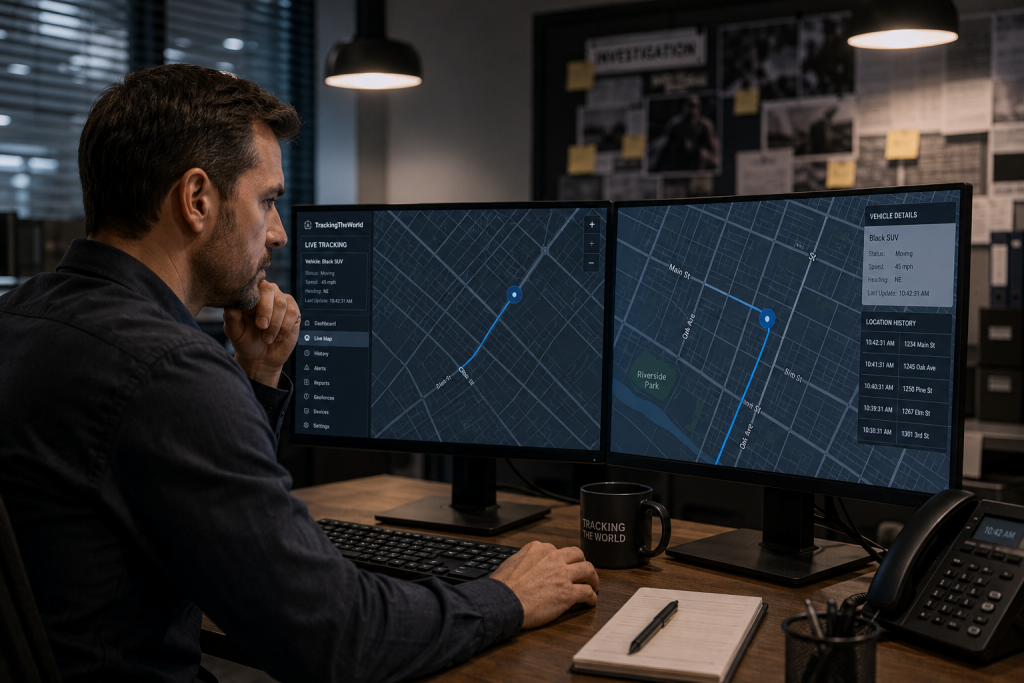
When a case depends on knowing where a vehicle is at that exact moment, tracking that arrives late or gets overlooked is worse than no tracking at all. That is where real-time covert vehicle tracking proves its worth, giving investigators, security teams, and fleet managers a live view of where a vehicle is and where it has been, while the device itself stays out of sight. Since 2003, we have built GPS tracking for law enforcement, government, private industry, and personal protection, and our vehicle devices are made for this kind of work.
| The Challenge | With TrackingTheWorld |
|---|---|
| Location updates arrive too late to act on. | Compact real-time trackers report a vehicle’s live position on a map. |
| A device that is easy to spot gets found and removed. | Small housings with hardwired, OBD, or battery options support discreet placement. |
| One vehicle, one narrow tracking need. | A full vehicle lineup covering cars, fleets, farm, mining, rental, and more. |
| No record of where a vehicle has been. | Location history and alerts through our GPS tracking software. |
Why Does Covert Vehicle Tracking Matter for Investigations?
The moment a tracker is noticed, its value drops to almost nothing. Keeping a device discreet lets you follow a vehicle’s movements without changing anyone’s behavior, which is the whole point of sensitive work. That is why real-time covert vehicle tracking fits situations where being seen would put the outcome at risk, such as:
- Protecting fleet and company vehicles from theft or misuse
- Recovering a vehicle after it goes missing
- Keeping watch on rental, lease, or high-value vehicles
- Supporting law enforcement, government, and private security operations
Each of these depends on accurate locations you can trust, delivered the moment you need it, not hours after the fact.
How Does Real-Time Vehicle Tracking Actually Work?
A tracker fixes its position using GPS satellites, then sends that location over a cellular network to our software, where it updates on a live map as the vehicle moves. Instead of reading a report long after the fact, you watch the vehicle in near-real-time and can look back over the exact route it took. Our platform is built to turn raw location data into something you can act on, including:
- Live position on a map that refreshes as the vehicle drives
- Location history so you can retrace where a vehicle has been
- Alerts you can set up around movement and other activity
You can even see a live tracking demo on our site before you commit to a device, so you know what the view looks like in practice.
Which TrackingTheWorld Devices Support Covert Vehicle Tracking?
We build a full range of vehicle trackers, so the right one depends on how you will install it and power it. Getting real-time covert vehicle tracking right starts with matching the hardware to the vehicle and the job. Our vehicle options fall into a few groups:
- OBD trackers such as the WT-OBD and WT-OBD 4G plug straight into the vehicle’s OBD port for a fast install, and the full WT-OBD 4G version can also read diagnostic codes.
- Hardwired trackers such as the AVL-50 4G, AVL-55, and AVL-300 series install inside the vehicle and offer multiple input and output options, with some supporting external GPS antennas, Garmin FMI, sensors, and voice.
- The multi-purpose Enduro Plus 4G covers vehicle use alongside personal and asset tracking, which helps when running wires is not practical.
Across the lineup, models differ by network (4G LTE, 3G, CDMA, or GSM/GPRS), install type, size, and certifications such as FCC and Verizon, so there is room to fit the device to the situation.
What Should You Look for in a Covert Tracking Setup?
Start with the vehicle, the power source, and how you plan to use the location data. The strongest setup pairs a device that installs cleanly and stays hidden with software that shows live location the instant you need it. For any team that leans on real-time covert vehicle tracking, a few questions guide the choice:
- How will your device be powered: hardwired, through the OBD port, or by battery?
- How quickly does it need to go in and come back out?
- Which cellular network has the best coverage where the vehicle travels?
- What do you need from the software: a live map, history, alerts, or all three?
Answer those, and the right device choice usually becomes clear. If you are not sure, our team can help you match a model to the situation.
Frequently Asked Questions
Is covert vehicle tracking legal?
It depends on your state and how your vehicle is used. As a general rule, you need to own the vehicle or have the proper authority to track it, and the rules are stricter for certain uses. Confirm what applies to your situation, and for law enforcement or investigative work, follow the required legal process.
How does a covert tracker stay out of sight?
We feature vehicle trackers that use compact housings. And you can hardwire them, or plug them into your OBD port, or even run them on battery power. This gives you several ways to place a device where it will not be noticed. The right option depends on the vehicle and how long the device needs to stay installed.
Can I track more than one vehicle at once?
Yes. We build our GPS tracking software to monitor multiple devices from one place, which is why it works well for fleets as well as single vehicles. You can view each vehicle’s live location and history in the same platform.
What cellular networks do your vehicle trackers use?
Depending on the model, our devices run on 4G LTE, 3G, CDMA, or GSM/GPRS. Coverage varies by area, so it is worth confirming which network fits your region before you choose, and our team can point you to the right device.
Talk to TrackingTheWorld
Ready to put real-time tracking to work without giving it away? Talk with our team about which vehicle device fits your investigation, fleet, or security needs. Call (650) 692-8100, email sales@trackingtheworld.com, or reach us through our contact page. We are located at 2360 East Bidwell Street, Suite 111, Folsom, CA 95630.