An LTE-M GPS tracker uses GPS to determine its location and an LTE-M cellular network to send that location to tracking software. It is commonly used for vehicles, equipment, trailers, and other connected assets that need reliable coverage with relatively low power consumption. This guide explains how it works and helps you decide whether it fits your job.
| Common tracking problem | How LTE-M helps |
| Batteries die too soon. | The device sleeps between short reports, so power lasts longer. |
| Old 2G and 3G networks are going away. | LTE-M runs on current 4G networks. |
| Moving assets lose their connection. | The link follows the device from tower to tower. |
| Installation takes too much work. | Many models plug in or mount without wiring. |
How do GPS and LTE-M work together?
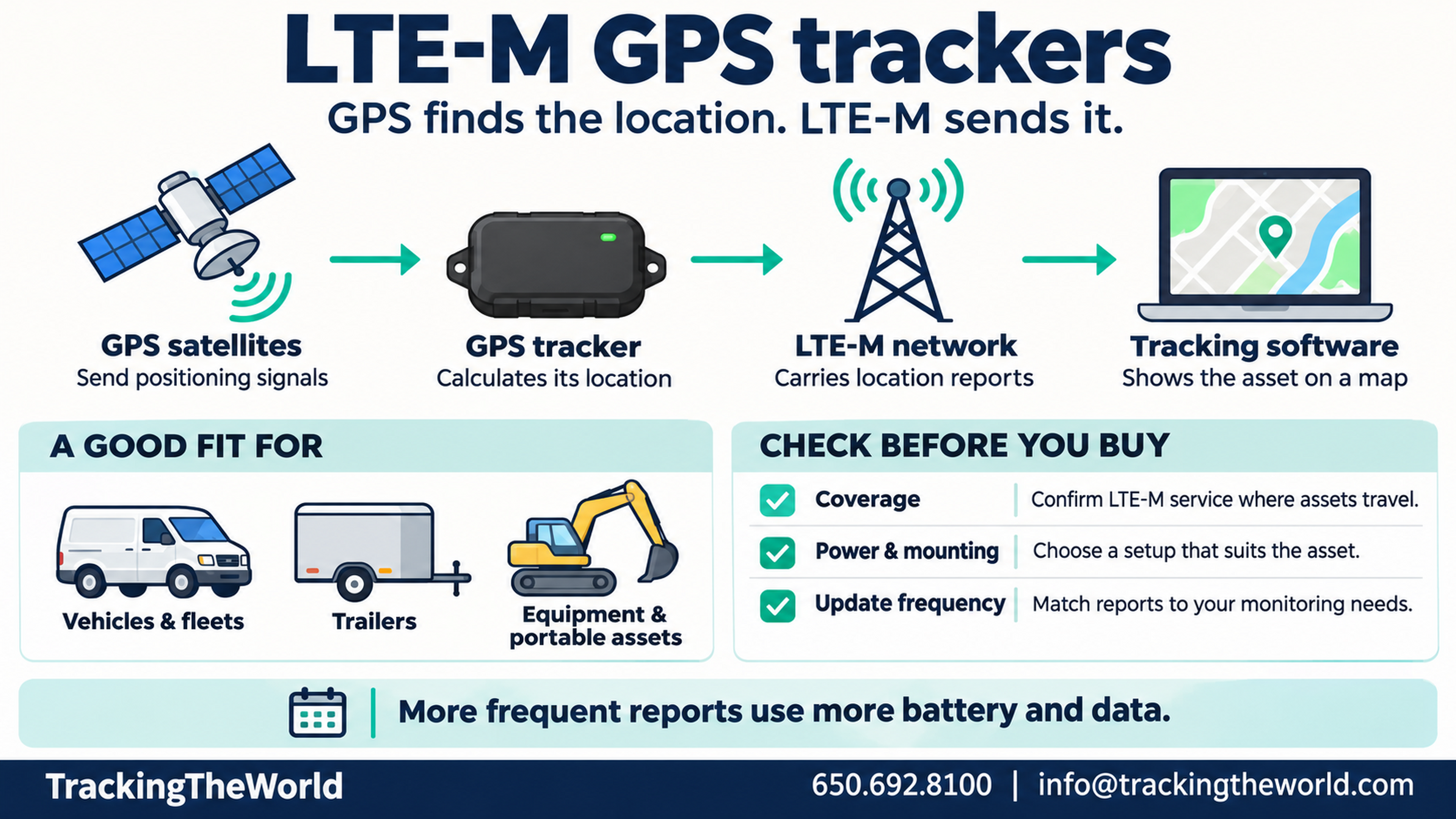
LTE-M stands for Long Term Evolution for Machines. It is a cellular standard built for connected devices. A tracker pairs it with GPS, but the two technologies do different jobs.
- GPS positioning: The receiver listens to satellites and works out where the device is. GPS only receives signals. It sends nothing.
- Cellular transmission: LTE-M carries that position over a carrier network to the tracking platform, where you see it on a map.
Think of GPS as the compass and LTE-M as the call home. Without the cellular link, the tracker knows where it is, but you never find out. Without GPS, the tracker can report in, but it has nothing useful to say.
Why is LTE-M built for devices instead of phones?
Phones need fast speeds for video, calls, and apps. Trackers send tiny messages. LTE-M gives up speed in exchange for three things that matter more to a tracker.
- Broader coverage: The signal often reaches deeper into buildings and trailers than a standard LTE link.
- Efficient power use: The device sleeps between reports, so a small battery lasts longer.
- Dependable transmission: The connection follows the device as it moves from tower to tower.
How does LTE-M compare with LTE, 2G, 3G, and NB-IoT?
- Traditional LTE: It is faster and built for heavy data. A location ping does not need that speed, and the extra power draw adds up.
- 2G and 3G: Many carriers have shut down or are retiring these older networks, so devices that depend on them may stop working.
- NB-IoT: It suits very small messages from devices that stay put. It handles movement less smoothly than LTE-M. The WT-OBD 4G, AVL-350 4G, and GAT-Pro 4G list NB-IoT support along with LTE Cat-M1.
When is LTE-M a good choice?
LTE-M works well for assets that move or sit for long periods and need steady monitoring. Three of our 4G models list LTE Cat-M1 support.
- Vehicles: A plug-in LTE-M GPS tracker like the WT-OBD 4G connects to the OBD-II port, so you can install it without tools. It also offers driving behavior monitoring, crash detection, and tow alarms.
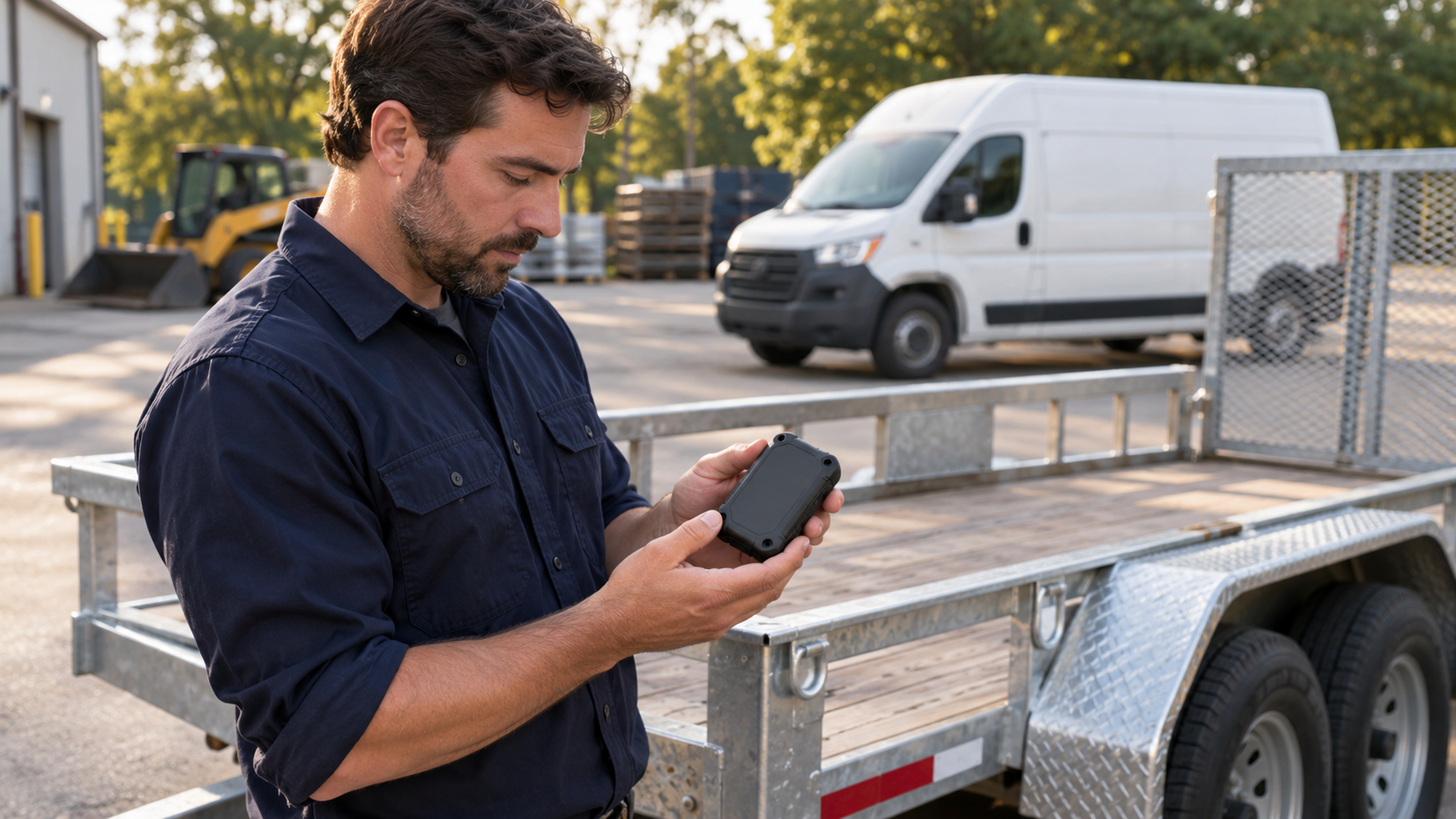
- Trailers, equipment, and portable assets: The GAT-Pro 4G is an LTE-M GPS tracker with an IP67 rating. It needs no wiring, offers an optional magnetic mount, and lists up to 7 years of standby time on its internal batteries.
- Fleets and ongoing monitoring: The AVL-350 4G is an LTE-M GPS tracker with serial ports, extra inputs, and a connection for a temperature sensor.
How does reporting frequency affect battery life and data use?
Every report wakes the device and sends a small amount of cellular data. More reports mean faster battery drain and more data use. Fewer reports stretch both. Standby time is not the same as frequent reporting, so pick the slowest schedule that still meets your needs.
When is LTE-M not the best fit?
LTE-M is not the answer for every job. It works only where your carrier supports it, so rural gaps are possible. It also suits small messages, not constant second-by-second updates or large data transfers.
Why does network compatibility matter when replacing old trackers?
A new tracker must work on a network your carrier supports. A like-for-like swap may fail if the old tracker used a retired 2G or 3G network. Check which networks serve your area first. Ask your carrier which networks it supports, and our team can help match a model.
What should you ask before you buy?
- Carrier coverage: Does my carrier support LTE-M where my assets travel?
- Power source: Do I need an internal battery or vehicle power? The AVL-350 4G runs on 8V to 32V DC.
- Update frequency: How often do I need a new location?
- Installation: Do I want a plug-in, wired, or magnetic-mount device?
- Certifications: Does the device carry the approvals my carrier requires? Our products page lists FCC and Verizon certification for the WT-OBD 4G and AVL-350 4G, and FCC, PTCRB, AT&T, and Verizon for the GAT-Pro 4G.
Frequently Asked Questions
Is LTE-M the same as 4G?
LTE-M is part of the 4G family, but it is designed for devices instead of phones. It uses less power and sends less data than the LTE on your phone. That trade works well for trackers.
Does LTE-M replace GPS?
No. GPS finds the location. LTE-M sends it. A tracker needs both to report where an asset is.
How long does an LTE-M tracker battery last?
It depends on the model and how often the device reports. The GAT-Pro 4G lists up to 7 years of standby time. Frequent reporting shortens that, so call us and we will help you plan.
Does LTE-M work indoors?
LTE-M often reaches deeper into buildings than older cellular links. However, GPS signals can still be weak indoors, so a fix may take longer. Mount the tracker with a clear view of the sky when you can.
Ready to choose a tracker? Call us at 650.692.8100, email info@trackingtheworld.com, or visit our contact page. Our office is at 2360 East Bidwell Street, Suite 111, Folsom, CA 95630.


Choosing a Commercial Fleet GPS Tracking System That Scales

Most fleets do not start out big. A company adds a few trucks. It tracks them with a basic app. Then it moves on. But trouble starts later, once the fleet outgrows that basic app. So choosing the right commercial fleet GPS tracking system from the beginning matters. It saves you from ripping out and replacing your setup down the road. At Tracking The World, we specialize exclusively in GPS tracking. We have done this since 2003. Our fleet platform manages a handful of vehicles or a few hundred, without forcing you to switch tools as you grow.
| The Problem | The Solution |
|---|---|
| Vehicle tracking works, but trailers, equipment, and drivers stay invisible. | One platform covering vehicles, trailers, towing, cold storage, dash cams, and more. |
| A system sized for 10 vehicles breaks down at 100. | Fleet tools built to manage a handful of vehicles or an entire fleet from one dashboard. |
| Reports arrive too late to change a route or catch an issue. | Real-time location data and alerts as conditions change. |
| Compliance tracking lives in a separate system, or nowhere. | Electronic logging device options built into the same fleet platform. |
Why does fleet size matter when picking a GPS system?
A system that fits your fleet today may not fit it in two years. So the platform’s ceiling matters as much as its starting price. Many entry-level GPS tools rely on a simple map view built for a handful of vehicles. That works fine at first. But once a fleet adds routes, drivers, and vehicle types, those tools tend to slow down. Often, they force a switch to something else entirely.
A commercial fleet GPS tracking system built for scale handles that growth without a disruptive changeover. Our platform manages fleets of any size, from a single vehicle to a large, multi-location operation. You run it all from the same dashboard.
What should a fleet tracking system actually cover?
A fleet is rarely just trucks. It often includes trailers, specialty vehicles, and equipment that need their own kind of oversight. So a tracking system should grow into all of it. For that reason, Tracking The World’s fleet solutions span several categories built for different parts of a fleet operation:
- Vehicle tracking for cars, trucks, and general fleet assets
- Trailer tracking for equipment that moves independently of a powered vehicle
- Towing solutions for repossession and recovery operations
- Cold storage temperature monitoring for refrigerated loads
- School bus and student monitoring
- RFID waste container tracking
- Dual dash cam tracking for driver and road-facing video
- Electronic Logging Device (ELD) compliance solutions
- Ambulance management tracking
With these options under one provider, a fleet manager avoids stitching together separate logins and separate vendors as needs change.
How does real-time tracking change day-to-day fleet management?
Real-time visibility lets a fleet manager act while a situation is still unfolding, not after the fact. For instance, a dispatcher who sees where every vehicle is right now can reroute around traffic. They can confirm a delivery window. They can respond quickly if a vehicle strays from its expected path.
Day-to-day, that visibility shows up in a few concrete ways:
- Faster response when a vehicle is delayed or off-route
- More accurate ETAs for customers and dispatch
- A clear location history if a dispute or incident needs review
- Less guesswork when planning routes and driver assignments
What role does compliance play in choosing a fleet system?
Compliance tools save a fleet manager from running logging and tracking as two separate systems. Tracking the World includes Electronic Logging Devices in its fleet lineup, alongside vehicle and trailer tracking. That means hours-of-service data and location data live in the same platform. You skip the separate login and the separate vendor relationship.
This matters most for growing fleets. As a company adds drivers and vehicles, keeping compliance and tracking together in one commercial fleet GPS tracking system keeps the administrative side from becoming its own full-time job.
What questions should you ask before committing to a provider?
The right questions before you sign on tell you more about a provider’s fit than any features list. Ask these of any fleet GPS provider:
- Can the platform manage both a small starting fleet and a much larger one later, without switching tools?
- Does it cover the specific vehicle and asset types in your fleet, including trailers or specialty equipment?
- Is compliance tracking, such as ELD, built into the same system as location tracking?
- How experienced is the provider, and how long have they specialized in GPS tracking specifically?
Tracking the World has answered that last question the same way since 2003. GPS tracking is the only thing we do. Our team, led by CEO Henri Maramis, built the company’s software and hardware around that focus.
Frequently Asked Questions
What size fleet is Tracking the World’s system built for?
It manages fleets of any size, from a single vehicle to a large, multi-location operation, all from one dashboard. That range lets a growing fleet stay on the same platform instead of switching providers as it scales.
Does the platform track more than just vehicles?
Yes. Beyond standard vehicle tracking, Tracking the World offers trailer tracking, towing solutions, cold storage temperature monitoring, school bus and student monitoring, waste container tracking, dash cam tracking, and ambulance management.
Is compliance tracking included?
Yes. Electronic Logging Device (ELD) compliance solutions are part of the fleet lineup. So you manage hours-of-service and location data within the same platform, instead of through a separate system.
How long has Tracking the World been in the GPS tracking business?
Tracking the World was founded in 2003 and has specialized exclusively in GPS tracking ever since. The company operates out of its corporate office in California and serves customers around the world.
A commercial fleet GPS tracking system should fit the fleet you have now and the one you are building toward. So, to see how Tracking the World’s fleet solutions can work for your operation, contact our sales team or call us directly at (650) 692-8100. Our office is located at 2360 East Bidwell Street, Suite 111, Folsom, CA 95630. You can also reach us by email at sales@trackingtheworld.com.


